
A patient presents with widespread erythematous raised wheals, some with central pallor, occurring within minutes of penicillin administration. The patient is hypotensive and has stridor.
What is the most appropriate immediate intervention?
A 61-year-old taxi driver with new diagnosis of angina asks about driving. He has had chest pain on exertion twice weekly, relieved by GTN.
What should you advise?
An 82-year-old woman with hypertension, COPD, and osteoarthritis attends for a routine review. She describes occasional exertional breathlessness but denies chest pain or syncope. She is widowed, lives alone, and is independent in ADLs.
On examination: BP 146/78 mmHg, HR 80 irregularly irregular. She has bilateral wheeze. Cardiac examination: a harsh ejection systolic murmur radiating to the carotids and a separate pansystolic murmur loudest at the apex radiating to the axilla. There is no peripheral oedema. ECG shows AF with LVH.
What is the most appropriate next step?
Match the following developmental skill to the most appropriate age of acquisition.
Skill: Building a tower of 6 blocks
Ages:
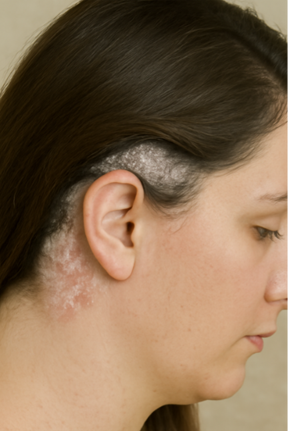
A 28-year-old woman presents with thick, silvery scaling affecting her scalp, extending slightly onto the hairline and behind the ears. She has tried over-the-counter tar shampoos without success.
What is the most appropriate next-line management in primary care?
A 63-year-old postmenopausal woman attends with severe vulval itching that has been worsening for several months. She describes tearing and pain during intercourse, andintercourse and has noticed the skin becoming thin and white. She is worried it may be cancer. On examination, the vulval architecture is distorted, with fusion of the labia minora and a pale, ivory-white, shiny appearance of the vulval skin. There are small fissures and ecchymoses but no obvious malignant lesions. She is otherwise well.
What is the most appropriate next step in management?
A 69-year-old man with a history of poorly controlled type 2 diabetes (HbA1c 82 mmol/mol), hypertension, and stage 3 CKD presents with a 6-week history of worsening right ear pain. He reports night pain, purulent discharge, and recent weight loss. He has been treated by his GP with two courses of topical antibiotic drops and one course of oral flucloxacillin without improvement.
On examination:
The GP is considering next steps.
Which is the most appropriate immediate management?
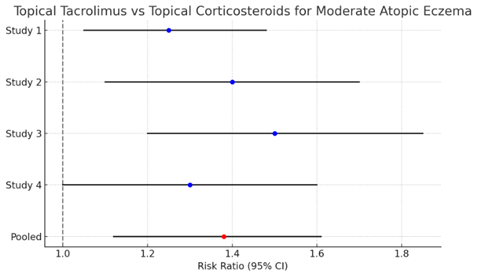
A Cochrane review compares topical tacrolimus with topical corticosteroids for moderate atopic eczema. The forest plot shows a pooled risk ratio for “physician-rated improvement”
Which interpretation is most correct?
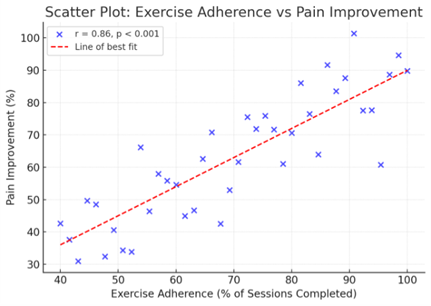
A scatter plot of exercise adherence (percentage of sessions completed) versus pain improvement is given below:shows r = +0.74 (p < 0.001).
Which interpretation is most accurate?
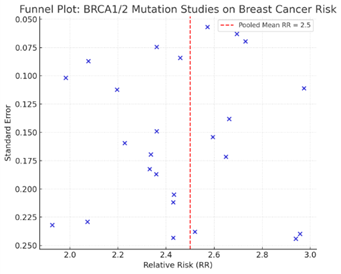
A funnel plot of BRCA1/2 mutation studies assessing breast cancer risk has the following results:shows a symmetrical distribution around the pooled mean relative risk.
Which interpretation is most accurate?
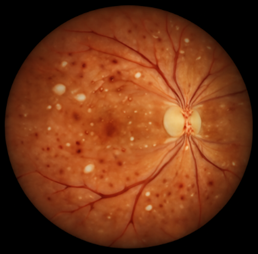
A 74-year-old retired bus driver with a 20-year history of type 2 diabetes and long-standing hypertension presents with his daughter, who reports he has been struggling to recognise people at a distance and has started to bump into furniture at home. He last attended his optician 5 years ago. His medications include ramipril, amlodipine, metformin, atorvastatin, and aspirin.
On examination in the GP surgery:
Which is the most likely underlying cause of his visual loss?
A 71-year-old retired bus driver attends your surgery with his daughter. He reports progressive visual decline, haloes around lights, and difficulty with glare. He has stopped night driving as headlights dazzle him. He has type 2 diabetes, COPD, and depression. Medications: metformin, tiotropium, sertraline, aspirin.
On examination:
Question:
What is the most appropriate GP action at this consultation?
A 74-year-old man is admitted following a left MCA stroke. He has dysphasia, right-sided weakness, and coughs when attempting to drink water. A bedside swallow assessment is abnormal.
What is the most appropriate immediate management?
A study reports 5-year survival rates for colon cancer:
If 100 patients are diagnosed at Stage II, how many are expected to survive at 5 years?
A local programme reports that cascade testing for FH raised first-degree relative detection from 15% to 65%.
What is the Absolute Risk Increase (ARI) and the Number Needed to Invite (NNI) to detect one additional FH carrier among first-degree relatives?
A 41-year-old woman attends asking about “the family cancer gene”. Her mother had breast cancer at 44, maternal aunt had ovarian cancer at 49, maternal grandfather had prostate cancer at 67. The proband has had a normal screening mammogram at 40, BMI 26, takes a COCP, and has two children (F 16, M 14). She asks (i) what her own risk is, (ii) whether testing can be ordered by the GP, and (iii) if her daughter should be tested now.
Single best action today?
Match the following clinical scenario with the most likely cause:
Kallmann syndrome
A 32-year-old woman of North African origin presents with secondary amenorrhoea for 18 months. She reports hot flushes, night sweats, and low mood. She has a past history of treated tuberculosis, a BMI of 29, and takes carbamazepine for epilepsy. She has two children (last pregnancy 6 years ago). She smokes 10/day. Examination reveals normal BMI distribution, no galactorrhoea, and no virilisation.
Blood results:
She is concerned about future fertility and bone health.
Which is the most appropriate next step?
A 42-year-old woman presents with fatigue and pallor. Her full blood count shows a low mean cell volume (MCV) and low mean cell haemoglobin (MCH).
A peripheral blood film demonstrates hypochromic, microcytic red blood cells with pencil cells.
What is the most likely diagnosis?
A 32-year-old woman presents with a 3-week history of easy bruising and recurrent epistaxis. She has no significant medical history, takes no regular medication, and had an uncomplicated pregnancy 2 years ago. She is otherwise well, denies weight loss, night sweats, or fever. Examination reveals scattered petechiae on her lower limbs. No lymphadenopathy or splenomegaly is noted.
Her bloods show:
What is the most likely diagnosis?
A 28-year-old British woman presents to your GP surgery with a 10-day history of intermittent fever, abdominal pain, constipation alternating with diarrhoea, headache, and malaise. She returned from visiting family in rural Pakistan 2 weeks ago. She did not receive typhoid vaccination before travel. PMH: hypothyroidism on levothyroxine. On exam: T 39.2 °C, HR 110, BP 100/70, spleen palpable, rose spots noted on abdomen.
Which is the most appropriate next step in primary care?
A 27-year-old man with moderate learning disability attends for a diabetes review. He is accompanied by his mother, who usually speaks on his behalf. He is verbal but struggles with complex information and becomes withdrawn when overloaded.
Which of the following strategies best demonstrates reasonable adjustment under the Equality Act 2010?
A 36-year-old man presents with right foot drop, distal sensory loss, and burning pain. He has a history of diabetes diagnosed at 18. Reflexes are absent.
What is the most likely diagnosis?
A 27-year-old patient tells you she “developed feelings” for you and asks for your personal number. She previously disclosed sexual assault.
What is the appropriate response?
You are reviewing spirometry traces for a 42-year-old man with chronic cough.
Results show:
A 68-year-old man with heart failure and hypertension takes ramipril, bisoprolol, and spironolactone. He has developed diarrhoea and vomiting over 24 hours. His BP is 95/60 mmHg.
Which advice best reflects “sick day rules” to prevent AKI?
You are covering an out-of-hours telephone list. Which caller requires immediate 999 transfer?
A 52-year-old man has persistent hypertension (165/95 mmHg) despite amlodipine and losartan.
He feels tired and has leg cramps.
Investigations show:
Na⁺ 147 mmol/L, K⁺ 2.9 mmol/L, bicarbonate 30 mmol/L.
Renin suppressed; aldosterone elevated.
What is the next most appropriate investigation?
During a busy duty clinic, a 34-year-old man with a history of bipolar disorder storms into your consultation shouting, “You’re all plotting against me!” He paces the room, clenches his fists, and refuses to sit.
What is the most appropriate immediate response?
A 23-year-old woman, G1P0, attends at 7 weeks with mild nausea and no red flags. She asks what role her GP will play in her antenatal care.
Which is the most accurate description?